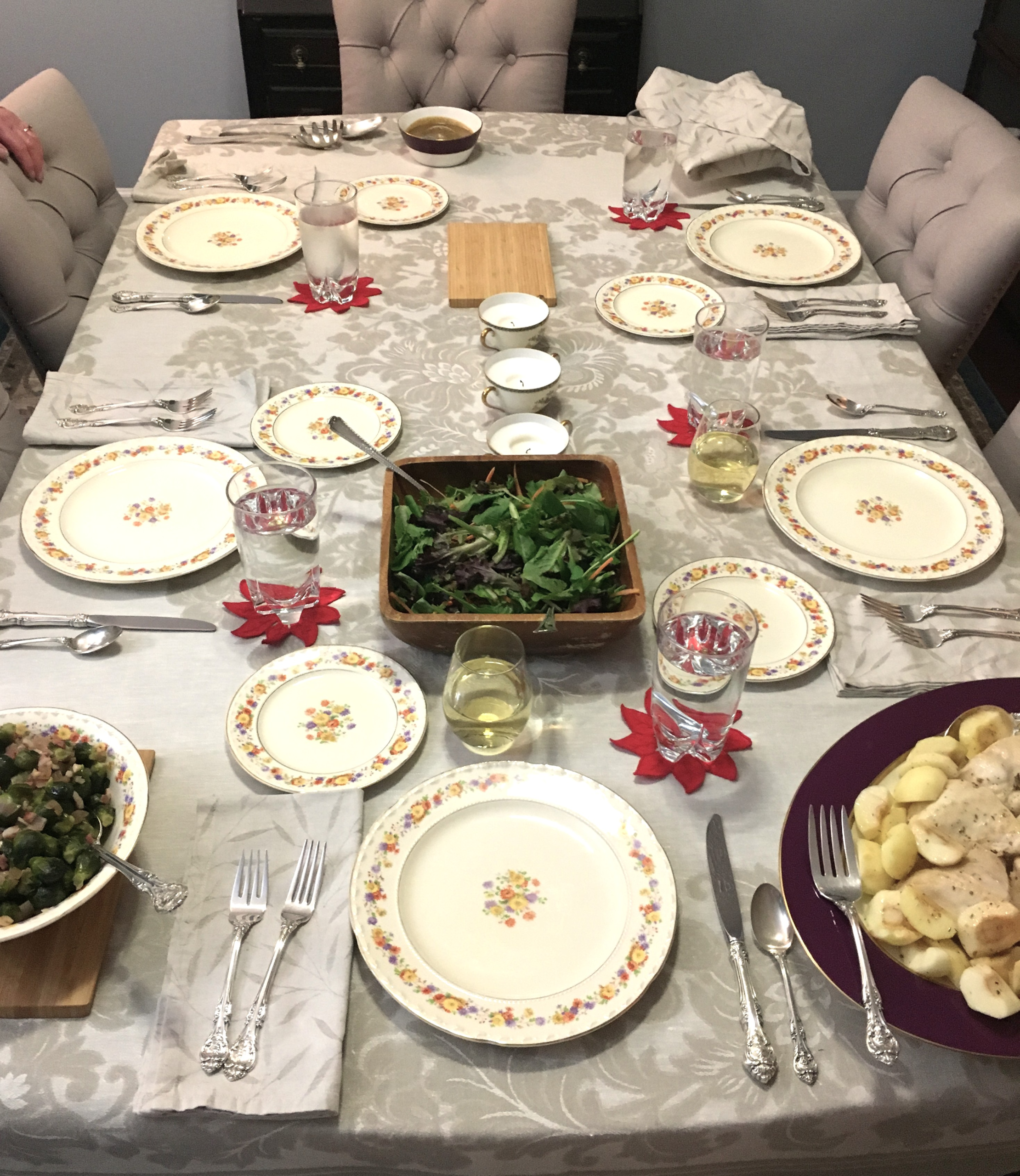
I’m sure there must be a lot of poetry about fresh snow looking like a damask linen tablecloth. If not, there certainly should be. There is something pristine about a table laid with that brilliant white cloth, the subtle pattern catching the candlelight, and the sheen of the pressed linen. It’s something that can never be caught from a rough polyester cloth, be it ever so bleached and starched.

In reading Below Stairs, written by Margaret Powell, kitchen maid turned cook, Mrs. Powell talks about setting the table for a dinner party. She says the finished table with the crystal and the silver looked like a scene from the Arabian Nights, “I do think that when you had the cloth on, even if it wasn’t a lace cloth but a snowy white damask, it looked a lot better than all these bits and dabs of mats do today, stuck all over the table.” While I sympathize with the placemat camp, (as would anyone who either laundered their own tablecloth or sold their firstborn to the drycleaners to press it) I have to agree.
I myself have a collected a ridiculous number of linen tablecloths over the years, so I thought I would dig through my etiquette and entertaining manuals and see what they have to say on the subject.

“Requisites for the Dining Table: Table-linen, etc.- Table-cloths (sic) of white damask, double or single, as fine as the owner’s purse admits, are used for the dinner-table, with large square napkins to correspond. The table should first be covered with a mat of double-faced cotton flannel wide enough to fall six inches below the edge of the table, all around. This under mat greatly improves the appearance of the table-cloth, which can be laid much more smoothly over this soft foundation.” ETIQUETTE, by Agnes H. Morton, 1907
“Laying the Cloth, &c.: In putting the cloth on the table, you should be very particular, observing, in the first place, to have the right side uppermost. This you may easily learn by looking at the hem and the fold. Likewise you must be very particular to have the bottom of the cloth to the bottom of the table. In most all dinner cloths that are spread for company, there is generally some ornamental work that is wrought on them, on some there is the family’s coat de arms, on others, baskets of flowers, birds, branches, &c. Then suppose there is a basket of flowers, the bottom of the basket should be towards the person at the bottom of the table, as the design should always go up the table; the centre of the table cloth should likewise go exactly down the centre of the table, and not hang an eighth of an inch longer at one end than the other.” Roberts’ Guide for Butlers & other Household Staff, by Robert Roberts, 1827

“The Linen: White damask is the usual cloth for a formal dinner (an occasional chic hostess uses a lace banquet cloth); linen and lace or a small lace cloth is appropriate for a small informal dinner. A silencing cloth is always used. Do remember to put the cloth on evenly, with the center crease along the exact middle of the table, and with edges even all around…Colored linen for dinner seems to be losing its popularity.” Book of Modern Etiquette, by Elinor Ames, 1941
Well, well, I’ll have to be sure to get out my ruler next time I lay the cloth with my family “coat de arms” on it. Because, yeah, that’s a problem…